



Why Vertical AI Wins
AI is moving from experimentation to real deployment inside companies, and that shift is exposing a familiar set of challenges. As organizations try to put AI into production, they’re discovering that success depends less on access to powerful models and more on trust, workflow fit, and execution inside real operating environments.
This moment mirrors the pre-2000s period of on-prem, enterprise software, when adoption hinged on trust, customization, and real-world deployment. Enterprise software didn’t spread because it was easy to distribute like product-led growth SaaS models. It took off because companies invested in pilots, integration, and proving value before rolling it out broadly. The same pattern is emerging today with AI.
Enterprises aren’t looking for one-size-fits-all AI platforms. They need systems built around their specific workflows, deployed through pilots, and adapted alongside their teams. Increasingly, value is created through domain expertise, integration, and close partnership.
This reframes the question of whether the AI economy is overvalued. The more important question is where durable value will concentrate. As AI adoption deepens, value accrues to applied, vertical AI that delivers measurable outcomes and fast time to value inside real markets.
That conviction is reflected across the Mercury portfolio. Companies like Otto in veterinary services, Medefy in benefits plan and healthcare navigation, Collide in energy, OmniScience in clinical trial management, and Voze in industrial sales are building AI-native systems around real operational workflows. Looking ahead to Fund VI, we will continue backing founders building AI companies the way enterprise software was actually adopted: through trust, custom deployment, and measurable impact.

News and Noteworthy Announcements
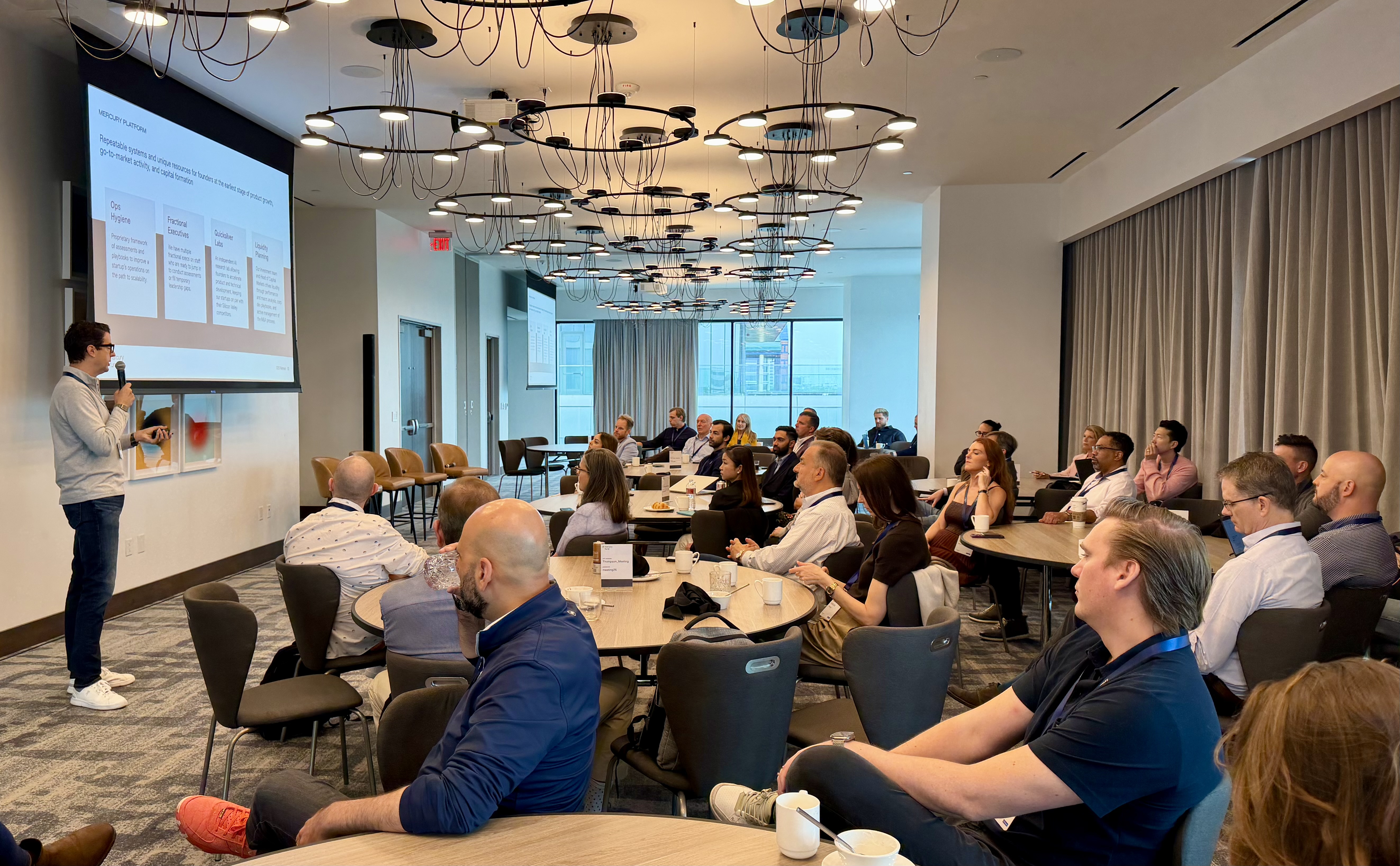
In early May, we brought together dozens of portfolio CEOs for the Mercury Fund CEO Retreat.
We covered a lot of ground: sessions on AI transformation and team effectiveness in the age of AI, a board management case study, a deep dive on growth-stage fundraising, and a discussion on M&A and liquidity planning.
There is no better reminder of why we do this work than being in a room full of CEOs building in this environment. We're lucky to get to partner with each and every one of them.
Mercury Fund Team Updates

Aziz Gilani advocated on Capitol Hill on behalf of the VC industry as part of the National Venture Capital Association Board's congressional engagements on policy issues like the DEAL Act and a unified national AI regulatory framework.

Heath Butler emceed the 2026 Rice Business Plan Elevator Pitch Competition which kicked off the main event, the world’s largest and richest intercollegiate student startup competition.

Money Moves is a new podcast hosted by Mercury Fund Partner Samantha Lewis, Profitr Co-CEO Ian Epstein, and OpenTrade CEO David Sutter. The podcast covers the future of global finance and how blockchain rails are enabling better, faster and cheaper systems for all financial services firms.
Our team had a big pressence at SXSW this year. We hosted the 3rd annual women in tech backyard escape, co-hosted a curated founder breakfast, joined PitchBook for a fireside discussion on the shifting fundraising playbook, judged a startup pitch competition, were official SXSW mentors, and spent the week building and strengthening relationships.
Alex Gras moderated a Go Slow to Grow Fast conversation, recorded live at Mercury Fund Day at the Ion, on how AI-native companies are leveraging Forward Deployed Engineers (FDEs).
We recently launched the 2026 Early-Stage GTM Report developed with input from 125+ B2B GTM leaders.This year's data captures how AI is reshaping the way teams are built and run, as well as insights on funnel conversion rate benchmarks, sales compensation modeling, and more.
Mercury Fund in the News
Aileen Allen spoke on AirCFO’s Funded podcast where she discussed what Mercury Fund looks for in early-stage founders, and how founders should evaluate and choose the right VC partners.
Adrian Fortino published an OpEd in Crain’s Detroit about Michigan’s opportunity to become a leader in the AI era. He argues that it’s not by competing with Silicon Valley on consumer software, but by leveraging its deep industrial expertise to build Vertical AI and Physical AI companies across sectors like manufacturing, healthcare, energy, and finance.
Blair Garrou spoke with Private Equity Wire where he shared that Middle America is increasingly well-positioned to build enduring tech companies as AI matures, thanks to stronger capital efficiency, deep industry expertise, growing support infrastructure, and more sustainable advantages in vertical software outside the coastal tech bubble.
Mercury Fund announced a partnership with More Than Capital to expand founder support and help portfolio companies scale in the United States and internationally.
Portco News
In March, Cart.com raised $180 million in growth funding, led by Springcoast Capital and Carlyse. The company was also ranked #35 on the Financial Times Fastest-Growing Companies of 2026 list, and named one of America's Best Startup Employers by Forbes.
Mercury Fund is proud to back Dreambase, the insights and analytics layer for AI-native teams building on Postgres, making it possible to build data-driven companies without large data teams. Congratulations to Dreambase founders Andy Keil and Kyle Ledbetter for closing their Seed round!
Nectar Social closed a $30M Series A led by Menlo Ventures with follow-on participation from True Ventures, Google Ventures, Mercury Fund, and others. They recently announced a strategic partnership with Reddit to give brands access to real-time Reddit community data through their platform. Co-founder and CEO, Mishab Uraizee, was also included in Forbes AI 50 Brink List.
Mercury Fund is proud to continue backing OpenTrade, co-leading their $17M Series A round alongside Notion Capital. The funding follows their recent $200M+ TVL milestone and $250M transaction volume in 2025. Congratulations to co-Founders David Sutter, Jeff Handler, Tom Niermann, and the OpenTrade team on closing this round!
RepeatMD launched a new AI-native product, Ageless, providing clinically-accurate, AI-generated before and after images to give patients photorealistic previews of treatments. Since its launch a couple of months ago, Ageless has led to record growth for the company.
Mercury Fund is excited to announce its seed investment in Rowan, the AI-native platform to help small business owners prepare for, and navigate, succession, a massive, $5T market problem. Congratulations to founders Steven Glod, Christopher Weaver, and team on closing their Seed round!
Starlab successfully completed a key company milestone: its Commercial Critical Design Review (CCDR). This achievement reflects years of rigorous engineering, close collaboration with NASA and strong coordination across their global team.