


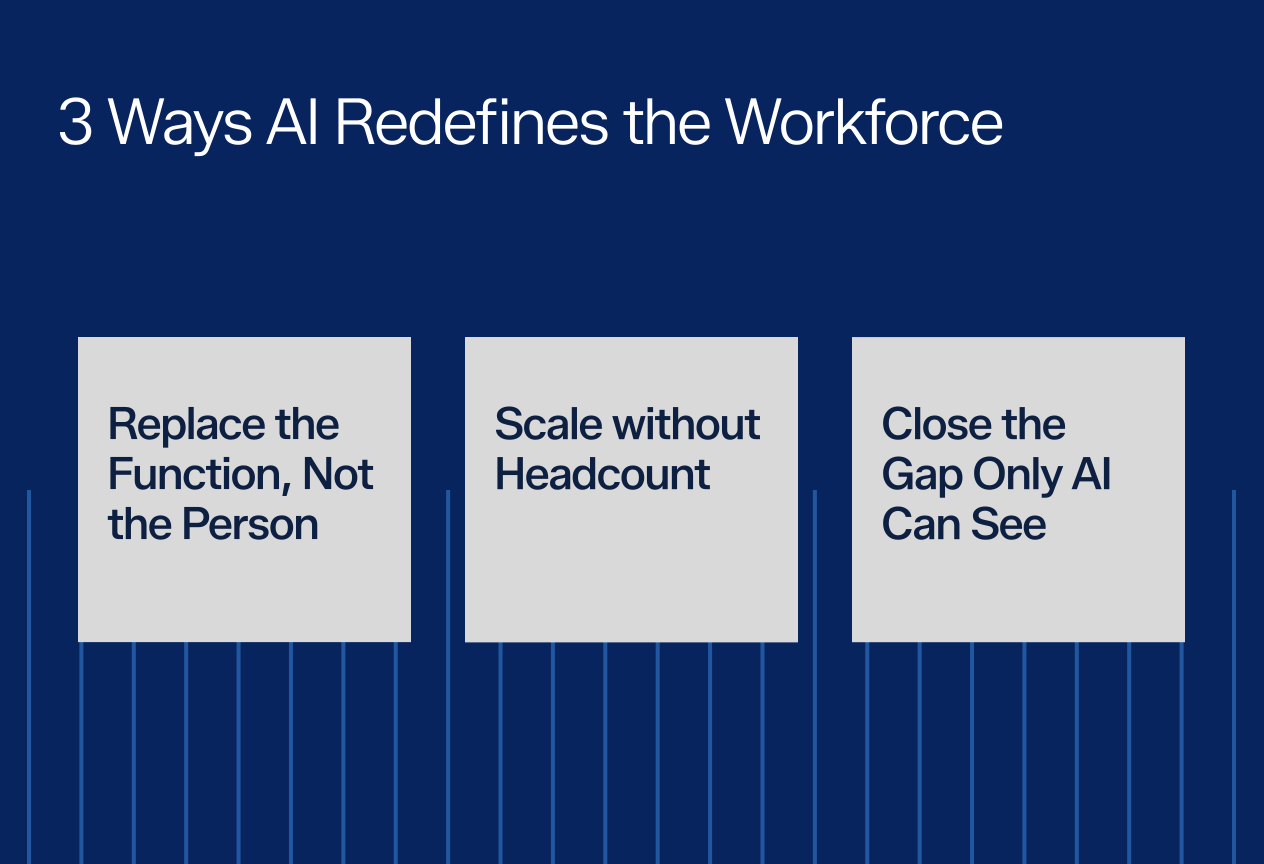
We keep coming back to the same question inside Mercury Fund: how do you actually execute AI-driven revenue acceleration inside a vertical industry, not just claim it's possible? After a lot of internal debate and a fair amount of pushing each other on it, we think it comes down to three consistent patterns.
Replace the Function, Not the Person
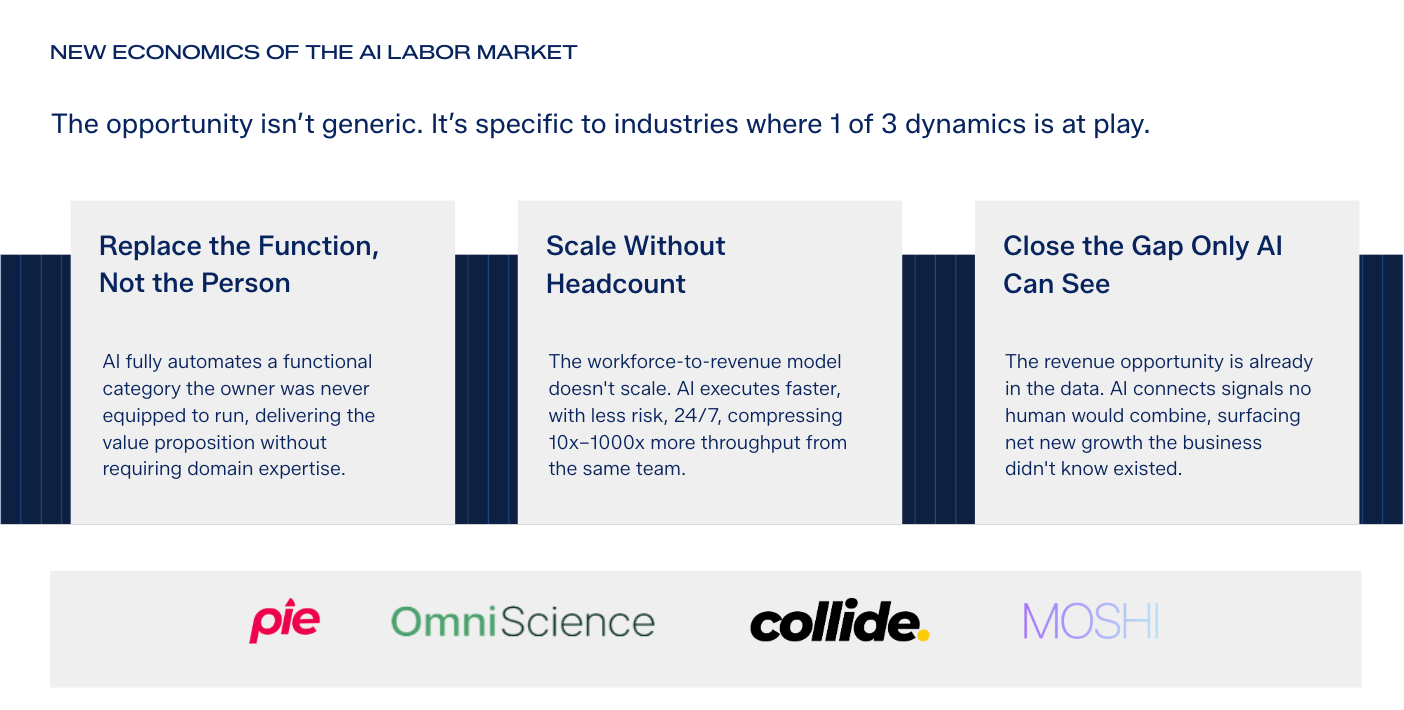
The first is replacing the function, not the person. This distinction matters because it's where a lot of the cost-side thinking about AI gets it wrong. Pie automates advertising for small businesses that never had the headcount to run a marketing function in the first place. Nobody lost a job. A capability that didn't exist before now does, and it's driving foot traffic into stores for under $10 a person.
Scaling Without Headcount
The second is scaling without headcount, and this is the one I think about most because it creates an opportunity for true leverage in old business models that had reached a plateau. Omniscience, which manages clinical trial data for pharmaceutical companies, closed over $20 million in bookings this year by letting trial teams run more trials without adding people, and by surfacing bad data early enough to cancel a failing trial before it burns millions of dollars. Collide does the same work for energy, freeing up landmen, regulatory agents, and petroleum engineers to focus on the judgment calls that actually require a person, instead of the workflow around them.
Closing Gaps that Only AI Can Identify
The third, and honestly the one I'm most excited about, is closing a gap that only AI can see. This is where AI combines first-party and third-party data to surface opportunities a person may have intuitively thought about, but never could have efficiently found manually, because the signal was buried across systems that don't talk to each other. Moshi gives institutional traders a tireless quant that processes information a thousand times faster than a human analyst. I call it ‘headless’ because the traders using it aren't sitting at a terminal all day; they're on the move, and Moshi does the analysis without ever touching the firm's proprietary data, letting the startup close deals fast inside large financial institutions without the usual compliance friction.
True Enterprise Demand
Here's the detail that should give any LP real confidence in this thesis: between Omniscience, Collide, and Moshi, these companies are working with four of the ten largest companies in America either as customers or in active pilots. Another portfolio company, Pie, serves some of the largest franchisors in the nation. Every one of those enterprises has asked the obvious question: why doesn't OpenAI or Anthropic just build this themselves? The answer, consistently, is that they aren't going to. The foundational labs are building platforms. The vertical application layer, the part that actually touches a trader's workflow or a pharma company's trial data, belongs to domain-expert founders who've lived inside these industries and understand exactly where the function needs to change.
That's the labor thesis in one sentence: the opportunity isn't generic, and it isn't about doing more with less. It's about knowing precisely which function to replace, which team to scale without adding headcount, and which gap in the data only AI can see efficiently. We think that's where the durable value in this labor market gets built, one industry at a time.