


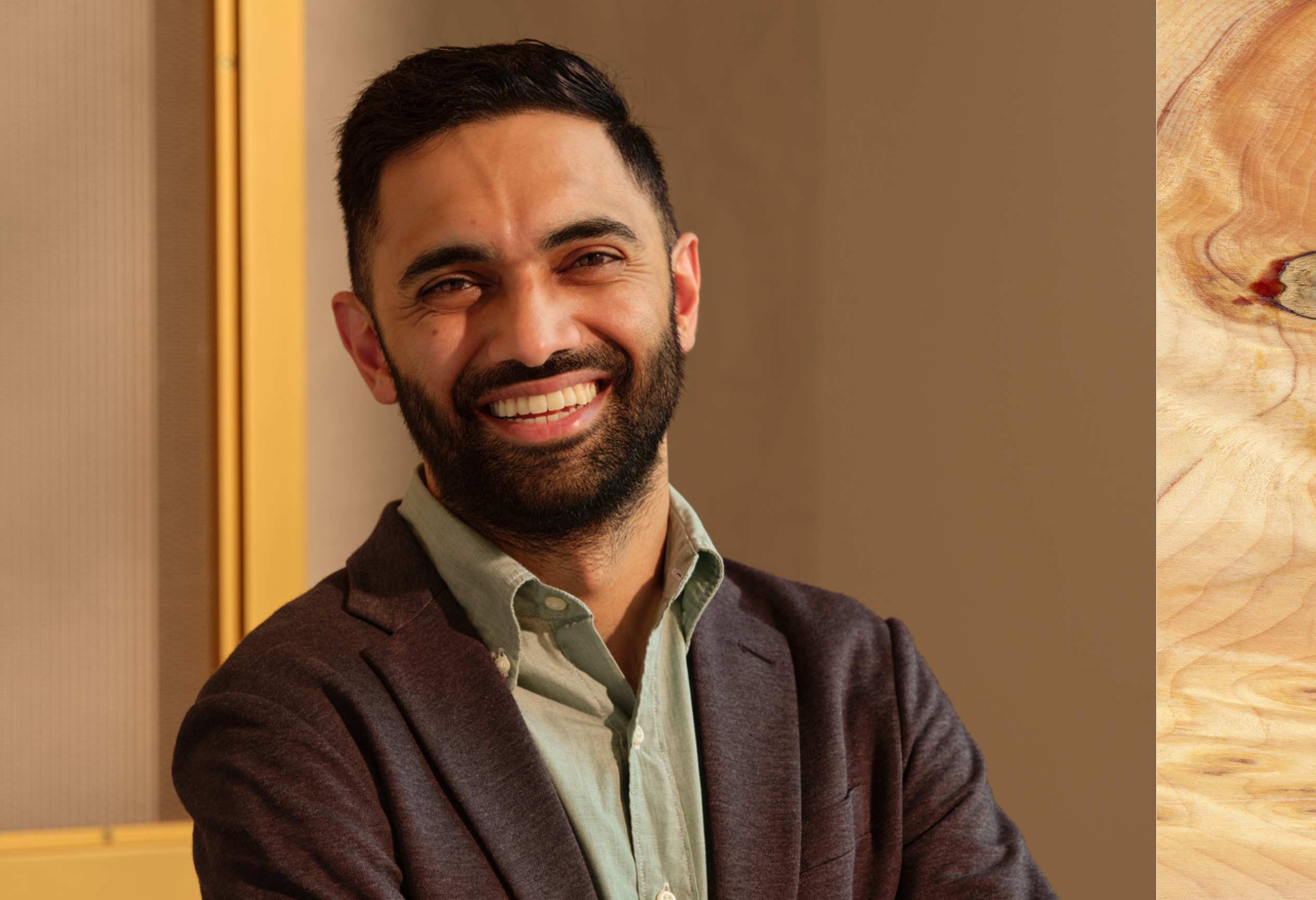
Sid Studied the HR Market and Built a Solution for It. Then, Took Action to Find Wizehire the Right Home Before The Market Moved
Sid Upadhyay was working with consultants, helping them make sense of personality assessment data, when he noticed something: companies struggling with dysfunction would bring in a consultant, and six months later morale was better. The assessment wasn't what made the difference but the advice did, along with the retooling of the business and the work of getting the right people into the right roles. None of that was available to a small business.
So Sid and his co-founders built Wizehire to change that. They bootstrapped the company through its early years to $3M+ ARR. Mercury co-led Wizehire's Series A alongside Amplo, and Tiger Global led a $30M Series B the following year.
Sid took Wizehire from self-serve SMB into mid-market and then rebuilt it as an AI-enabled recruiting platform. Sid saw consolidation coming to HR tech early enough to find the company the right home with Paychex, a partner Wizehire had worked alongside for years.
“Sid is the textbook definition of a high-growth tech founder,” said Heath Butler, Mercury Fund Partner and Wizehire Board Member. “Sid has deep domain expertise in his industry, he's technical enough to lead a development team, charismatic enough to lead the sales organization, can articulate a compelling market opportunity for investors, and most importantly, he has a relentless commitment to execution. We were proud to back Sid and would do it again, if given the opportunity.”
Here's Sid's story, in his own words.
What were you doing right before you started Wizehire, and what made you finally pull the trigger to go all in on this idea?
"I was a software engineer and my co-founder was a consultant who created the DISC personality assessment. I was helping clients with data science and while I wasn't initially a believer in assessments, I started working with clients and saw a pattern. A company would be dealing with dysfunction, a consultant would fly in and administer the assessment, and six months later morale was better. Clearly something was going on, so we dug in. The assessment wasn't magic. The difference came from the consultant, the advice, retooling the business, and aligning people into better roles.
That kept nagging at us. I was in a job that was fun, but my co-founder and I kept asking: could we make this experience available to small businesses and help them hire better?"
What did the earliest version look like?
"It was a very skinny product. Version one was a spreadsheet to help a hiring manager prioritize who to interview. Wizehire eventually became an end-to-end hiring platform: awareness of the role, thinking through requirements, compensation analysis, candidate analysis, interviewing, and onboarding. But that first version was thin.
Early on, we also innovated on human-in-the-loop advisory. When you build for a small business owner, they're busy and they wear many hats. You can't expect them to have all the context. You have to give them advice, and figure out how to bake that into the platform."
Tell us what you built, the problem you solved, and for whom.
"Wizehire helps companies hire the right candidates, faster. We support companies with every step in the hiring process from attracting candidates through job board postings, candidate matching based on skills and prior experience, sending and signing offers, retaining new hires, and more.
Our most lucrative move was partnerships. Instead of building features, we relied on add-ons and finding the right partners to de-risk it. We sold insurance products as a channel partner, and at one point even SMB loans. We didn't believe in a marketplace, because if you put five choices in front of this customer, you create too much decision friction.
That early investment in partnerships eventually led to our acquisition. We sent a lot of business to Paychex's PEO, one of their highest lifetime value (LTV) products.
We built Wizehire for SMB and mid-market companies. The Bureau of Labor Statistics says there are millions of SMBs, but the question became: how are you going to get in front of them? Our insight was to go deep into specific verticals. We uncovered in our data that once we had about 100 customers in a vertical, organic growth started to tick up. You reach a center of trust. I'm biased, but I think if you're building for SMB, you have to think vertically."
What verticals have you been the most successful in?
"We got sophisticated about evaluating verticals. We looked at how large they are, how often they hire, and how hard it is to hire, which tells you whether the product can actually add value. We weren't going to enter nursing for example, because the labor supply wasn't there. We started in real estate, and at one point during a boom we were handling one in five hires in that vertical. That let us leapfrog into other verticals. Today our favorite is legal. Lawyers love to talk to their friends, which helps with word of mouth growth and that center of trust I mentioned earlier. Legal also has a mix of hard-to-fill and easy-to-fill roles, so you earn trust with a couple of quick wins before you take on the harder hires."
What do you think you understood about the problem you were solving that most people don't?
"We thought about the problem in the context of the end user. We didn’t get hamstrung by how the rest of the market defines it. Enterprise recruiting looks one way, mid-market looks another, and SMB looks another. The critical thing was having the flexibility to say, “look, we don't need to check all those boxes, we just need to be great at a subset of things.” A lot of our competitors borrowed features from upmarket products. Those features are built for professional HR users, not for the prosumer that SMB really is. We had that to our advantage."
What are some of the hardest decisions you've made, and would you make the same decision today?
"We started bootstrapped, self-serve, and very downmarket. We had good growth but not great churn. Going multi-vertical gave us great growth, but we kept seeing that retention dynamic, so we made the jump from SMB to mid-market. We made that move when SMB and enterprise hiring were both falling and mid-market was the only reliable sector.
Tackling mid-market meant retooling the business. So we went from a self-serve, organic marketing motion to sales-led, account management, and much larger ACVs. I think we were a little slow at that, but those were the right moves. Then, just as we were growing in the mid-market, rate hikes put pressure on growth and client preferences moved toward platform consolidation versus buying point solutions. We had to pivot again. At this point AI models were capable enough that we could become an end-to-end AI-enabled recruiting assistant, and partner with large HCMs we were losing deals to. This returned us to a very R&D-focused business. These pivots are hard, but if you know the end destination they’re worth the hard work.
A lot of the hardest decisions were about people. You know in your gut that you have to make a move, and you give people a few extra turns. Those turns come at a real cost, in runway and opportunity cost. When we moved from SMB to mid-market, we had a product leader whose focus was on volumes of data, survey analysis, and behavioral metrics about our oldest customers. What we shipped wasn't what our newest customers needed at that moment. I grew as a leader by recognizing there's a bigger purpose. I can give someone one or two quarters, but I can't give you four. The AI pivot took personnel changes too, and that was hard. What I took away is that you owe people clarity and context, and that these changes are for the whole team’s benefit."
What's a strongly held belief you had at the start of your founding journey that you've since changed your mind on?
"There's kindness to a person, and then there's kindness to everyone. Early on, as bootstrappers, we gave a lot of people a lot of runway. It's great to make mistakes and learn in low-risk areas, but we were slow to bring in seasoned players for the most important roles and challenges. The belief behind that was culture, the idea that we could grow everyone from within. When I was a young IC, all I'd seen was a company raise a new round, a new leader come in, and a lot of change happen that was never explained. This taught me you have to explain the change. You want to invest in your team, but you have to pick the right bets. If you give someone a very high-risk shot out of kindness, you're almost doing them, and the company, a disservice."
What made you decide to go out and raise venture capital, and how did you approach your fundraising process?
"It was a group decision. We were in one vertical at the time and having a lot of impact, and we wanted to replicate that success in other verticals. Then the pandemic hit, hiring dropped, and revenue fell 50%. We were about to launch a hospitality vertical and decided not to, which was good timing given the pandemic’s lasting impact on hospitality hiring. Instead, we expanded into adjacent verticals: mortgage, legal, and insurance, because those were much more stable during the pandemic. That worked, and we actually grew faster than Indeed during the recovery. That's when we knew this was the moment, and we raised our Series A later that fall.
We were new to venture capital but I worked my network. My first conversation was with a top tier VC, through a former CEO I knew, and I completely flubbed the meeting. I wasn’t prepared and didn’t have the reps under me.
We wanted expertise, not just capital, because we hadn't been down this road before. We really appreciated that about Mercury. The partners had been founders themselves and had seen the ups and downs first-hand. For the rest of the round, we wanted access and other perspectives. Amplo was a feeder to firms like Bessemer, Insight, and Tiger.
I’d tell founders raising their first round two things:
- Think about their blind spots, and find investors who fill them.
- Get your reps in before you pitch the firms you want most. You'll get a lot of feedback, and you have to decide which feedback is right and polish the message.”
How did you meet the Mercury team?
"When we were just getting started and bootstrapping the company, I did consulting work to pay the bills, including for a friend's oil and gas consultancy. After that company sold, two of its founders went on to start Ambyint, which became a Mercury portfolio company.
When I was in college at UT, Infochimps, another Mercury-backed company, was headquartered in Austin. So I knew the brand and founders spoke highly of the Mercury team. I can’t remember who made the intro at first, but I knew they were the right partners for us at the time."
If you were starting over today with everything you know now, what's one thing you'd do differently?
"Embrace your naivete if you're in a new market or problem. But the bigger thing, especially early in your founder career, is to think really hard about the market. This journey is a decade long, it's a lot of hard work, and you won't necessarily have signal until much later. Be a student of your market. Know it cold and know the history, because it really does rhyme and repeat. I only became a student of it later in the journey. Today, I think it's inexcusable not to know your market inside and out."
Wizehire recently exited to Paychex. What made you decide to exit at this time?
"This came from becoming a student of the industry. A lot of M&A comes down to timing and I believe startups get bought, not sold. Founders shouldn't obsess over competition, but they should obsess over what's going on in the adjacencies. In certain verticals, there's no activity for a decade, and then there's a moment when a decade’s worth of deals happen. We were starting to see signs of that in HR tech so seriously considered our options.
One question founders should consistently ask themselves is whether their market is bundling or unbundling? You want to build a startup when the market is unbundling, and when the market turns toward bundling, it might be time to make a move.
We started to see the market moving back toward bundling, and at the same time AI was creating a platform shift. Putting those two facts together, our thesis in Q2 of 2025 was that the consolidation we saw in the dot-com and SaaS eras would happen again, probably within three years. Then in August of 2025, Workday announced it was acquiring Paradox and SAP announced it was acquiring SmartRecruiters.
The buyer universe for large M&A in HR tech is small, and AI requires heavy investment, so not every company will make it. In 2024 we'd focused the business on rebuilding around our agent. Then we ran a process and talked to everyone. Today, only one platform in our space hasn't announced a deal. At the peak, G2 tracked around 400 ATSs, and now it's about 170. This industry went through its full life cycle in a very short time. It's a game of musical chairs, and when the music stops, you need a seat.
For us, Paychex was the right home. We'd partnered with them for years, we had good synergies, and we were already cross-selling. As their partner, we didn't refer business to anyone else, and that mattered. You want a place that will be great for your team and great for your customers, and we found that with Paychex."
You’re a prolific content consumer. What's the last book or podcast that changed how you think about something?
"It’s late September in 2026 and there’s a lot of doubt right now about the AI cycle. We're all concerned about the large labs taking market share and about models becoming commoditized. I recently listened to a pretty geeky conversation with the founder of TypeSafe; they've built a new decision model that has taken off. What I took away was that when you’re actually close to the frontier, there's still so much opportunity. It was affirming to hear a fresh take from someone building his company and his models in a different direction, and succeeding.
We can all fall victim to the hive mind. I’ve also been thinking about how a lot of the content we consume is secondhand, and that we should get as close to first-party insights as we can. I don't listen to much of the aggregate commentary anymore - All In, A16z podcast, etc. I try to listen to the people who are building, who have hands on the keyboard, who can't sleep because demand is so high."
What's something that would genuinely surprise people to learn about you that wouldn't be obvious from your LinkedIn or resume?
"I grew up in Uganda. We moved to the U.S. when I was 10 because my family had the opportunity to apply for a visa. My mom, who is incredible, took it almost without thinking. We landed in New York in August 2000 and eventually moved to a rural town in Washington with about a thousand people, where my family ran a hotel."
Sid built Wizehire around a simple idea: small business owners deserve the same hiring expertise large companies take for granted. He delivered hiring expertise to small businesses one vertical at a time. During COVID, he rebuilt revenue after the pandemic cut it in half. He took the company upmarket when the market demanded it and rebuilt it again for AI. And because he studied his market closely, he saw consolidation coming early enough to choose Wizehire's home instead of waiting for the music to stop. That kind of discipline is rare, and it's the lesson we'd want every founder we back to hear. We're proud to have backed Sid since the Series A.